
ZO.RRO II for
Glass Industry
Zero Carbon Cross Energy System for Glass Industry
Project Run Time: 01.08.2023-31.01.2027



Zero Carbon Cross Energy System for Glass Industry
Project Run Time: 01.08.2023-31.01.2027
The results of ZO.RRO 1 have shown that taking merely individual measures into account cannot maximize the full potential that exists in terms of striving for energy efficiency and decarbonization within the industrial sector. It is important to instead adopt an approach that covers all fields of action that exist. Therefore, the aim of the ZO.RRO 2 project is to show how a highly available, sustainable and economical electrical energy supply can be implemented, using companies within the Thuringian glass industry and metal processing industry as models.
With the exception of the chemical industry, which requires gas as a raw material for material products, there is a clear trend towards the electrification of production processes. Process heat in particular can be alternatively supplied by electricity, which decarbonizes production when it is supplied by renewable energy. The core process itself is usually highly specialized and characterized by specific ancillary conditions.
In addition to the core process, which is usually the most energy intensive, production processes are characterized by a number of secondary processes. In the case of the glass industry, these include pre-processing steps such as mixing, crushing and blending, as well as post-processing steps such as shaping, cooling and packaging. Furthermore, general basic processes such as space heating and cooling are additional consumers.
The spread of electromobility through the addition of charging options for employees on the company premises, as well as the potential addition of mega watt charging systems (MCS) which are currently in the development for truck logistics, only adds to electricity-intensive load.
The derivation of decarbonization strategies for companies is therefore complex and multi-layered. ISO 50001 in conjunction with the Sankey diagram is currently the established standard method for developing and presenting decarbonization strategies. While some energy data is already recorded automatically by energy management systems, there are still a considerable number of companies in which energy data is only partially digitally recorded or not at all. Furthermore, no direct correlations to the production processes can be derived from the energy data. As a result, a man-hour intensive analysis step is necessary during the energy consultation, which is also heavily dependent on the specialist knowledge in the company. By deriving Sankey “target states” from Sankey “current states” as a result of the consultation, the automated consultation process can also be optimized overall.
From the glass industry example it is evident that the intermediate- and short-term conversion to all-electric furnaces would require a considerable increase in the grid connection capacity and the electrical energy to be provided. A renewable energy supply is challenging to achieve due to the continuity of the melting process and the space availability constraints on the plant site. The glass industry sites are distributed in clusters across individual regions, meaning that the increased grid connection capacities are concentrated in the distribution grid. Furthermore, the furnaces are converted in blocks, meaning that the required grid connection capacities must be made available promptly. It must also be taken into account, particularly in the case of energy-intensive melting processes, that even short-term interruptions can lead to considerable quality losses and even production downtime or even the destruction of the production plant.
Therefore, securing the power supply plays a significant role. Direct current (DC)-based electrical distribution systems are already being used in industrial processes for reasons of efficiency, but are limited to factory or building grids. In the context of industrial decarbonization, direct energy efficiency potentials can arise through low losses when integrating renewable energy systems and direct current consumers (storage, drives, electromobility) and indirect resource efficiencies through higher utilization of operating resources and synergy in system services.
In addition to conserving energy, energy costs can also be reduced by optimizing energy procurement. This includes the establishment and expansion of in-house generation capacities, as well as the flexibilization of the operating mode, in which it is possible to react to variable energy supply on the corresponding markets. On the one hand, this can be reflected in variable tariffs; on the other hand, flexible operation can also be marketed as an energy service (e.g. balancing power, peak shaving). This does not result in a direct increase in efficiency, but the primary energy consumption for electrical energy can be indirectly reduced, which in turn can be attributed to the production sites through energy upstream chain balancing. Furthermore, income can be generated in the form of compensation or reduced grid charges, which in turn reduces energy costs. The approaches are known from research and development, but there is a need for research into the standardization of control in the industrial environment. Furthermore, cost- and CO2-reducing interactions between production planning/control and energy availability are unknown, especially in the SME environment, and are therefore not used. Transferable solutions are needed here.
The following target picture the ZO.RRO 2 project results from the 4 fields of action:
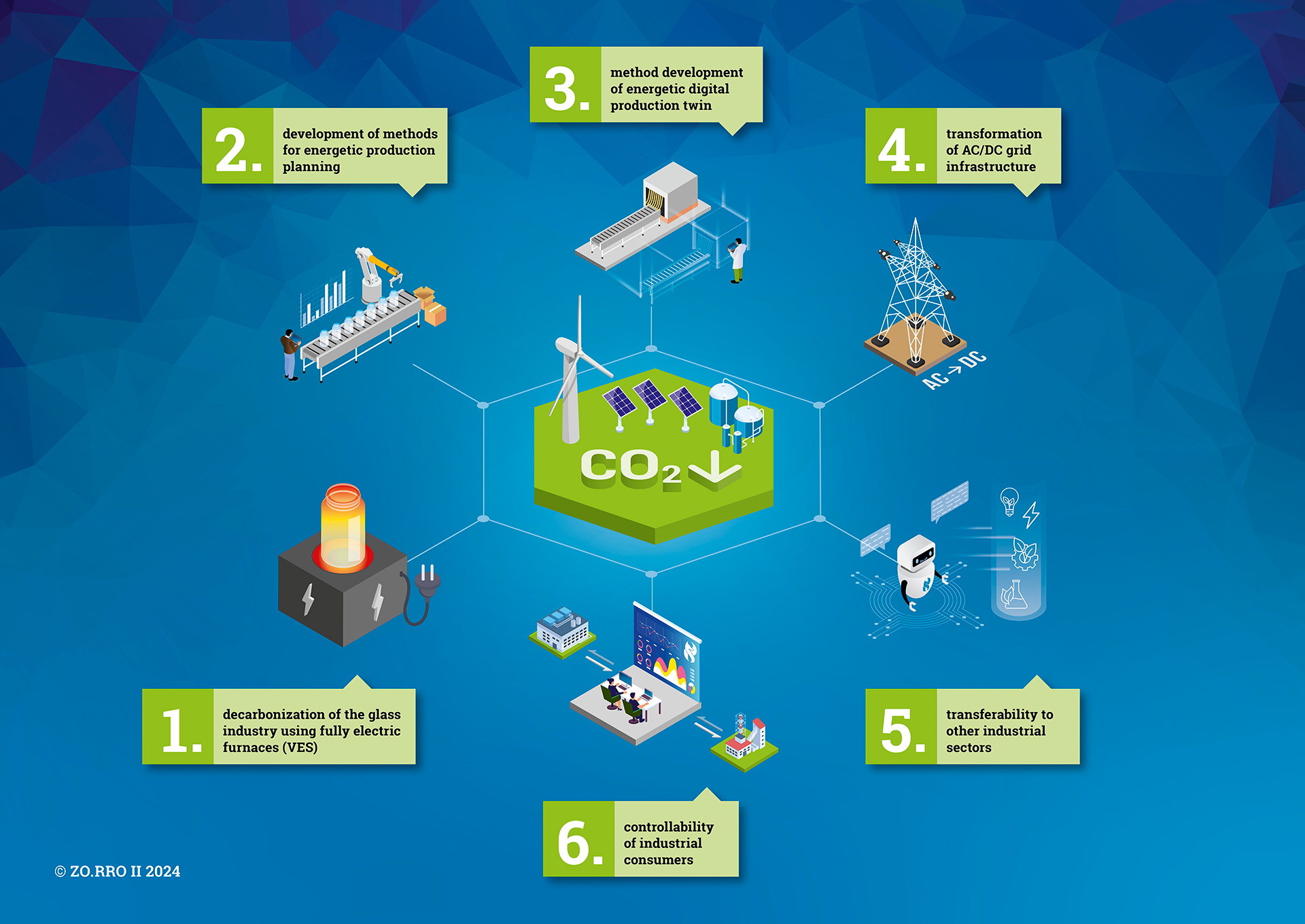

Development of energy supply concepts using a specific example (Schleusingen site) to reduce the energy consumption of glass melting by means of VES
Development and evaluation of plant networks based on direct current to increase efficiency using a specific example (Schleusingen site)
Derivation of redundancy concepts (emergency power concepts) using a specific example (Schleusingen site)

Development of methods to optimize operation and production planning under uncertainties
Development and validation of a method for taking into account variable energy availability and the feedback effect of the grid infrastructure in production planning and control
Development and validation of a method for transferring this location-specific model to production processes from other sectors

Modeling and validation of an energetic production image using a specific example (Schleusingen site)
Development and validation of a method for generating an energetic production image
Development and validation of a method for transferring the model at the specific location for the same production process at another location (different boundary conditions, different structure)

Development and validation of a method for testing the supply concepts with regard to applicability for energy services (balancing energy market, peak shaving,...)
Development of scenarios and simulation models (grid, generation, consumption) to compare the public supply in AC or DC technology
Development of an evaluation method to compare AC or DC technology
Derivation of a planning methodology for DC technology for the special requirements of industrial consumers

Development and validation of a method for automating the energy consulting process (energy supply concepts "Sankey actual state" to "Sankey target state"), taking into account the technological options
Evaluation of the methods and associated savings potential at industrial companies in various sectors
Development and provision of special measurement technology for automatic process modeling for different production processes
Provision of a prototypical special measurement technology for the identification of typical profiles and modeling by evaluating the time series and supraharmonic spectrum (fine analysis)

Conception and testing of algorithms for the targeted use of control signals for the optimized and time-synchronous use of renewable energies by production plants
Development and testing of a system for recording and optimizing the CO2 footprint
Development of methods for the semi-automated generation of energy management models using AI approaches
Validation under practical aspects by implementing the developed special measurement technology in the laboratory demonstrator and in the real demonstrator.


General Information
Department of Electrical Power Supply
The focus of the Department of Electrical Energy Supply is on systems engineering considerations of the electrical energy supply system. In this context, the department deals with future requirements for energy transmission and distribution, the integration of new basic technologies, optimal system management and the modeling and analysis of the entire energy system from the transport network level to the system on the end consumer side.
Department of Information Technology in Production and Logistics
The research focus of the Department of Information Technology in Production and Logistics is on innovative modeling and simulation methods for production and logistics. In this context, the department works on shaping the idea of the "digital twin" and contributes to shaping the future topic of "Industry 4.0" with its expertise in the areas of interoperability standards and automatic model generation.
To evaluate and optimize the energy efficiency of production and logistics systems, the department is developing various solutions based on hybrid simulation approaches and deep learning methods that are able to forecast the energy and power requirements of a production system, including its progression over time.
Department of Energy Use Optimization
The research focus of the Energy Use Optimization department is on the development of methods for predicting energy demand profiles and fluctuating feed-in patterns of renewable energies as well as the ecological and economic optimization of energy procurement, storage operation and the use of energy flexibility. To this end, the department is researching AI-based methods for forecasting and generating energy models for optimal energy use planning in the face of uncertainty.
Department of Production Engineering
The research focus of the Production Engineering department includes cooperative planning for the design of economically stable value chains. To this end, the department derives current challenges from practice and develops models to explain production logistics relationships and multi-criteria decision-making. Furthermore, tools and instruments for resource planning and control are designed for customer-driven variant manufacturers.
Department of Electrical Power Supply
Concept development to ensure power quality and availability for conversion to all-electric furnaces in the glass industry
Concept development for industrial supply using direct current technology
Development of methods for deriving generic production models
Field of Energy use optimization:
Mapping and evaluation of various use cases and the associated target functions in energy operational planning (self-consumption maximization, peak shaving, CO2 minimization)
Design of an overall architecture in terms of functions and roles for the implementation of process optimization and interaction of the subsystems: energy operational optimization, production planning and digital production twin
Generalization of the operational management methodology to other industrial use cases using AI approaches and application to different groups of industrial consumers.
Department of Information Technology in Production and Logistics:
Development of methods / process models for the generation of energetic production twins
Concept for the use of energetic production twins for the analysis and control of production and logistics systems, using the example of the glass industry.
Department of Manufacturing engineering:
Conceptual design of energetic flexibility in production planning in the glass industry by determining relevant planning parameters
Development of a method for production planning with energy flexibility to minimize energy costs for process manufacturing and its subsequent further development for discrete manufacturing
Coordinates the Network
Fundamental method development in the areas of public grid supply and production processes as a link between the industrial partners
The Applied Systems Engineering branch of the Fraunhofer Institute of Optronics, System Technologies and Image Exploitation employs around 130 people at 4 locations with its headquarters in Ilmenau. Together with customers, it develops customized, resilient and future-oriented systems engineering solutions for complex, dynamic and time-variant processes in the fields of energy and water supply, cyber security, land and underwater robotics, data spaces and ICT ecosystems as well as disinfection.
The "Cognitive Energy Systems" department develops and researches pioneering key technologies in the field of energy systems engineering in the areas of energy technology, energy informatics, energy logistics, cyber security, cross-sectoral energy systems and cognitive assistance systems in Germany, Europe and worldwide.
Efficient and standard-compliant integration of energy-related operational optimization in industrial companies and interaction with production planning as well as measurement and control of industrial consumers
Creation of local RE forecasts and mapping the uncertainties of local generation
Energy operational planning and optimization, taking into account the dynamic load behaviour of production and sector-coupling secondary processes, including the resulting uncertainties, as well as comparison with purely deterministic approaches
Coordination of the requirements for the metrological recording of consumption data and energy planning data as a basis for controlling industrial consumers
Method development in the field of energy management that can be transferred to standardization and standardization as a link between the industrial partners
Wiegand-Glashüttenwerke GmbH is a medium-sized family business with a tradition of over 450 years and is managed in the 4th generation by Nikolaus Wiegand and Oliver Wiegand. The four plants in Steinbach am Wald (Bavaria), Ernstthal, Großbreitenbach and Schleusingen (Thuringia) produce more than eight million glass containers for the food and beverage industry every day. This makes Wiegand-Glashüttenwerke GmbH, with its approx. 2000 employees, one of the largest container glass and PET preform manufacturers in Germany and not only has specialist knowledge in the field of glass production, but has also been a pioneer in glass recycling for decades and relies on tradition and modern technology at the same time.
Definition of requirements for the integration of all-electric furnaces (VES) in the production site
Development of operating concepts
Development of supply and safety concepts for VES
Has specialized knowledge in the field of glass production, especially for the conversion to VES
Use of the methods and concepts developed to optimize the conception and design of the VES
Das Ingenieurbüro für Energiewirtschaft GmbH, kurz IfE GmbH, wurde 1993 gegründet und beschäftigt aktuell 35 Mitarbeiter an den Standorten Steinbach-Hallenberg, Erfurt und Meiningen. Wir agieren als technisch-wirtschaftliche Unternehmensberatung sowohl als Backoffice für Netzbetreiber, Stadtwerke und regionale Energieversorger als auch im Bereich des Energieeffizienzmanagements für Industrie- und kommunale Unternehmen.
Anwendung von KI-Methoden zur Digitalisierung des Beratungsprozesses
Übertragung der Effizienzsteigerung aus der Glasindustrie auf weitere Branchen
Anpassung der wissenschaftlichen Methoden auf die praktischen Anforderungen der Industrie
Sicherung der Übertragbarkeit und Skalierung von Dekarbonisierungsstrategien in die Industrie
Die KoCoS Technology Group entwickelt, produziert und vertreibt als weltweit tätige Unternehmensgruppe Mess- und Prüfsysteme für Betriebsmittel im Bereich der elektrischen Energieversorgung und laseroptische Inspektionssysteme zur Qualitätsüberwachung. Mit dem Know-how aller Mitarbeiterinnen und Mitarbeiter löst KoCoS tagtäglich herausfordernde und ungewöhnliche Aufgaben in Beratung, Entwicklung, Fertigung und Vertrieb.
Entwicklung und Bereitstellung von Spezialmesstechnik zur automatischen Prozessmodellierung für unterschiedliche Produktionsprozesse
Industrialisierung der Methode in Form eines Produktes und Bereitstellung für Verbund als Prototyp
Die Kompetenz der TEAG mit Ihren, im Projekt beteiligten Tochtergesellschaften liegt in der systemverantwortlichen Verteilnetz-Betriebsführung und deren Weiterentwicklung in Thüringen (TEN), in der dienstleistenden Umsetzung und Weiterentwicklung des Messstellenbetriebes (TMZ) sowie in der Belieferung von Kunden mit Elektrizität, Gas und Wärme, inklusive der Beratung und Dienstleistung bei der Umsetzung von Energieeffizienzmaßnahmen und –kompletten Energielösungen.
TEAG:
Situationsanalyse bei Industrieunternehmen anhand neuartiger Methoden
Untersuchung und Bewertung von Energieeffizienz- und Substitutionsmaßnahmen anhand neuartiger Methoden
Konzeptableitung zur Speicherung von Erneuerbarer Energie mit Hilfe von dezentralen Batteriespeichern oder/und Form von Speichern von grünem H2
Konzeptableitung von Erdgassubstitutionskonzepte, Elektrifizierung des Fuhrparkes und Maßnahmen zu deren Umsetzung
Neuartige CO2-Bilanzierung und Strategieberatung zur Dekarbonisierung
TEN:
Versorgungstechnische Bewertung der zusätzlich zu elektrifizierten Glasindustrie-Netzlasten hinsichtlich Anforderungen an Versorgungs- und Ausfallsicherheit, sowie Netz- und Spannungsqualität
Aufnahme und netzplanerische Analyse der bestehenden regionalen AC-Netzinfrastruktur im betrachteten Versorgungsbereich der Thüringer Glasindustrie unter Berücksichtigung des durch die Dekarbonisierung bedingten Leistungs-Mehrbedarfes
Erstellung eines alternativen DC-Netzmodell inklusive der Modellierung aller dazu notwendigen Betriebsmittel und netzplanerische Analyse der alternativen DC-Versorgung der zusätzlich zu elektrifizierenden Glasindustrie-Lasten
Technischer und ökonomischer Vergleich AC/DC und Bewertung der Varianten hinsichtlich Eignung zur Erfüllung Versorgungsszenarios
TMZ:
Konzeption und Erprobung von Algorithmen zur gezielten Nutzung von Steuerungssignalen zur optimierten und zeitsynchronen Nutzung von Erneuerbaren Energien
Ableitung von Mess- und Marktanwendungsfällen / Designvorschlägen für das intelligente Messsystem (inkl. Steuerbox) im Bereich künftiger registrierenden Lastgangmessung (RLM)
Skalierung der Methodik auf weitere Industrieanwendungen und Prüfung der netztechnischen Beherrschbarkeit der parallelen Reaktion von ganzen Gruppen industrieller Verbraucher auf zeitsynchrone Markt- bzw. Preissignale
Steuerung mit Ziel der Vermeidung teurer Lastspitzen und Maximierung Nutzung erneuerbarer Energien, Analyse ggf. vorhandener Zielkonflikte mit der gegenwärtigen Netzentgeltpraxis, Vorschläge für eine Überarbeitung
Erprobung der Algorithmen sowie deren Umsetzung in einer messtechnischen Lösung in einer geeigneten Testumgebung sowie aktive Mitwirkung der Erprobung vor Ort bei einem der Industrie-Projektpartner
Schlussfolgerungen für Erweiterung der messtechnischen Standardisierung im RLM-Bereich
Einbringen von Spezialwissen in den Bereichen, Verbrauchserfassung, Netzplanung -und Betrieb sowie Energieservices mit
Anpassung der wissenschaftlichen Methoden auf die praktischen Anforderungen der Industrie und Ableitung neuer Geschäftsmodelle
Nutzung der entwickelten Methoden zur Verbesserung der eigenen Geschäftsfelder
Sicherung der Übertragbarkeit und Skalierung von Dekarbonisierungsstrategien in der Industrie aus mehreren Perspektiven

Anforderungsdefinition zur Integration VES in Produktionsstandorte der Fa. Heinz Glas
Ableitung der Übertragbarkeit auf die Produktionsstandorte der Fa. Heinz Glas
Einbringen von Spezialwissen im Bereich der Glasherstellung insbesondere für die Umstellung auf VES
Beurteilung der Übertragbarkeit auf abweichende Prozesse der Glasindustrie

Unterstützung bei der Erarbeitung spezifischer Szenarien zu Energiebereitstellung und Versorgungssicherheit
Unterstützung bei der Bewertung von Lösungskonzepten und ihrer Auswirkungen auf das Höchstspannungsnetz
Einbringen von Spezialwissen zur strategischen Netzplanung sowie DC-Anwendungswissen

Erprobung der entwickelten Methoden am eigenen Produktionsprozess
Ableitung von Dekarbonisierungskonzepten mit den entwickelten Methoden
Evaluierung Einsparpotentiale anhand der entwickelten Methoden
Einbindung neuartige Messtechnik zur Einzelerfassung und Steuerung von Maschinen
Einbringen von Spezialwissen im Bereich energieintensive metallverarbeitende Industrie
Evaluationsbeispiel für die Übertragbarkeit auf andere Industriebranchen
Beurteilung der Übertragbarkeit auf eigene Industriebranche